Cumberland Sausage vs. Lincolnshire Sausage: What Makes Cumbria’s Different?
Cumberland Sausage vs. Lincolnshire Sausage: What Makes Cumbria's Different?
Walk into a proper butcher's shop in Cumbria and the first thing you see is the coil: one unbroken rope of sausage, thick as your thumb, curled up like something that has just settled down for the night. Ask for a Cumberland sausage a few hundred miles south and you may well be handed something pale, fine-textured and twisted into neat four-inch links. It is not the same thing, and Cumbrians will tell you so.
Set a Cumberland beside a Lincolnshire and you are looking at two different ideas about pork. One is coarse, peppery and meat-heavy, built to be cooked slowly in one piece. The other is sage-scented, finely ground and shaped into links that fit a frying pan and a bread bun. Both are worth eating. They simply behave differently, and knowing why makes you a better buyer and a better cook.
The easiest way to hold it in your head is as a single dial. Everything that makes a Cumberland a Cumberland — the rough grind, the firm, dry bite, the way it wants to be cooked in one long piece — is a decision the Lincolnshire makes the other way round. Turn the dial and you get a different sausage, a different dinner and a different set of rules in the kitchen.
The Short Version
If you remember nothing else: Cumberland is about the pork and the pepper, Lincolnshire is about the sage. The grind, the shape and the cooking time all follow from that.
- Cumberland: coarsely ground pork, high meat content, generous pepper with supporting herbs, sold as a coil in a natural casing, cooked slowly.
- Lincolnshire: pork with a higher proportion of rusk, ground finer, sage-dominant, sold as twisted links, cooked briskly and eaten hot.
- Both: traditional British pork sausages with protected regional identities, and both at their best bought from a butcher rather than a supermarket chiller cabinet.
Coarse Against Fine: The Grind Does the Work
A Cumberland is minced through a coarse plate, so you can still see what you are eating. Chunks of shoulder and belly sit together in the casing rather than blurring into a paste, which gives the sausage its chunky, almost steak-like texture and a bite that resists your teeth for a moment before giving way. Because there is so little rusk holding it together, a Cumberland relies on the meat itself, on a well-packed natural casing and on gentle cooking. Hurry it and it will split, spill its fat and turn dry in the pan.
A Lincolnshire is ground much finer and leans more heavily on rusk, the dried breadcrumb that soaks up fat and seasoning and keeps the texture smooth. The result is softer, more uniform and far more forgiving. It browns quickly, holds its shape in a hot pan and slices cleanly, which is exactly why it has always been a breakfast sausage, a hot-dog sausage and the sausage you drop into batter for toad in the hole. Rusk gets a bad name, but in a Lincolnshire it is doing a job: it carries the sage and keeps the interior moist under high heat.
Pepper Against Sage: What You Taste First
Seasoning is where the two really part company. A Cumberland leads with black pepper — often a great deal of it, coarse-ground so you can see the flecks — backed by salt and sometimes a little thyme, mace or nutmeg. It should taste of pork first and pepper second, and it should be assertive enough to stand up to onion gravy.
If you can see the sage, it is a Lincolnshire. If you can see the pepper, it is a Cumberland.
Lincolnshire's signature is sage, the herb that the county's market gardens once grew in enormous quantities for stuffings and forcemeats. A good Lincolnshire smells sweet and savoury before it even hits the pan, with pepper and occasionally nutmeg in a supporting role. Where a Cumberland wants to be the main event on a plate, a Lincolnshire is a seasoning in its own right — which is why it works so well in a bun with mustard, on a breakfast plate, or under a blanket of mash.
The Coil and the Link
The Cumberland coil is not just a piece of theatre. One continuous sausage means very little exposed surface, so the meat steams gently inside its own fat and stays juicy. Traditionally the long rope was hung in the chimney to smoke and dry, a way of keeping pork edible through the winter, and long coiled sausages are still sold by length rather than by the piece. Cooked whole and then cut into thick rings, a coil serves four people from a single pan and looks generous on the table. Butchers also make party-sized rings weighing a kilo or more, which need nothing more than an oven and a little patience.
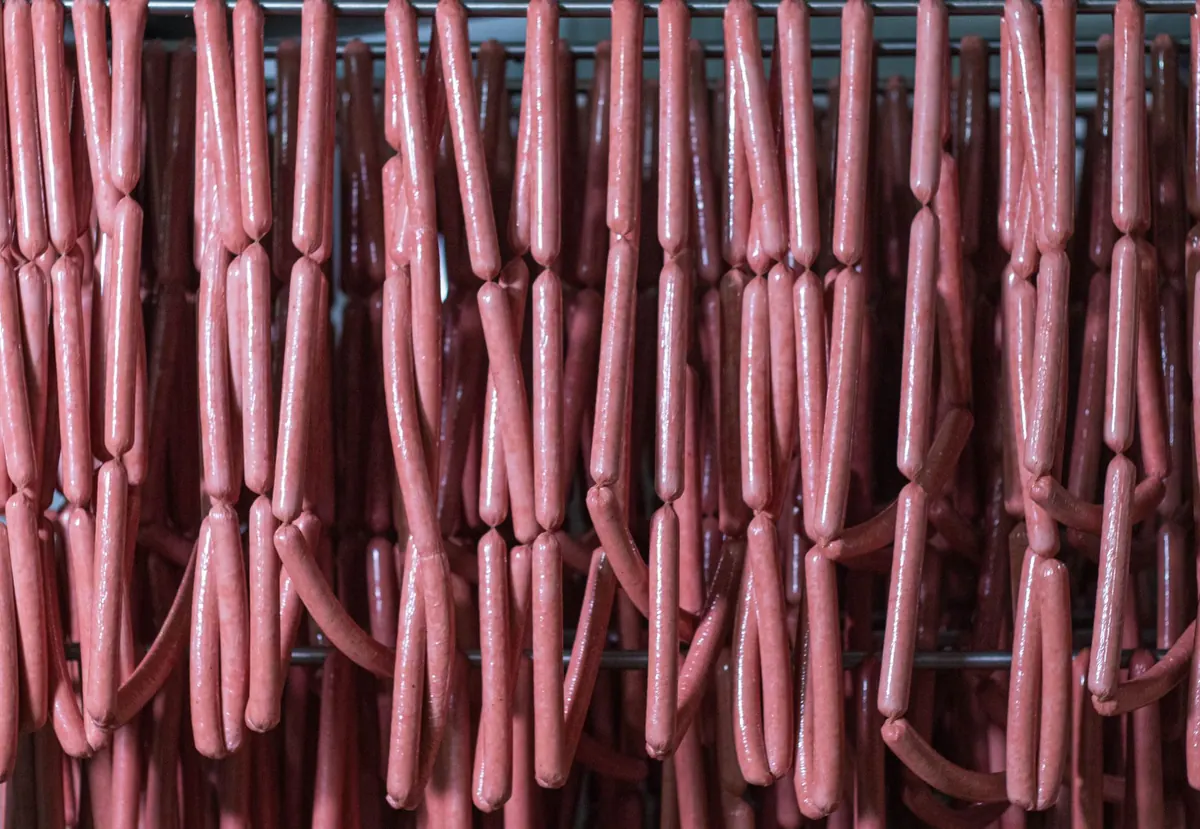
Links, by contrast, are about surface area. Each twist gives you an end to brown and a portion that fits neatly between two slices of bread. They cook in a fraction of the time, brown on all sides and are easy to count out for a family breakfast. The shape is a direct consequence of the recipe: a fine, rusk-bound sausage has the elasticity to be twisted tightly without bursting, while a coarse, meat-heavy one would rather be left in one piece.
Names, Rules and the Impostors
Cumberland sausage has had Protected Geographical Indication status since 2011, which means the name can only be used for sausage made to a defined specification within Cumbria: a coarse cut, a natural casing, a minimum meat content and that characteristic coil. That protection matters because "Cumberland-style" sausages are sold everywhere, and many of them are nothing of the sort — a fine, pale, rusk-heavy banger wearing a Cumbrian name. Lincolnshire producers have long argued that their own sausage deserves the same treatment, and the county's butchers are generally the loudest voices insisting on real sage and a proper pork content.
The practical rule for shoppers is simple. If the packet says "Cumberland-style" or "Lincolnshire-style" and lists a meat content in the fifties or sixties per cent, you are buying a generic banger with a regional accent. If it says Cumberland sausage and was made in Cumbria, the rules are on your side.
How to Cook Each One Properly
Cooking a Cumberland
- Do not prick it. All that flavour is in the fat, and pricking simply lets it out into the tin.
- Cook it whole, low and slow: 20 to 25 minutes in a moderate oven, or in a covered pan with a splash of stock, then uncover and brown.
- Alternatively poach the coil gently in water or stock for 10 minutes, then finish it in a hot pan for colour.
- Rest it for a few minutes, then cut into thick rings and serve with mash, onion gravy and something sharp, such as braised red cabbage or a spoonful of mustard.
Cooking a Lincolnshire
- Fry or grill over a medium heat for 12 to 15 minutes, turning now and then, until deeply browned.
- Keep the heat moderate. Sage and rusk will scorch before the middle is cooked if you rush them.
- For toad in the hole, brown the links first, then bake them in hot batter so they flavour the pudding from within.
- Serve in a bun with mustard, alongside eggs and tomatoes, or with buttery mash and a green vegetable.
Buying Well: A Short Checklist
- Read the meat content. Look for 80 per cent pork or higher, especially in a Cumberland.
- Check the casing. Natural casings give a better snap and hold a coarse filling together.
- Look at the colour. Fresh sausage should be pink-grey, not raw pink and glossy, and never grey-brown.
- Ask about the grind. A butcher will happily tell you which plate the mincer was set to, and whether the sausage is coarse or fine.
- Buy what you will eat. Coarse sausage freezes well; thaw it slowly in the fridge rather than in the pan.
- Be sceptical of the word "style". It usually means the name is the only regional thing about it.
Which One Should You Buy?
Buy a Cumberland when you want dinner to feel like an occasion: a coil in a roasting tin, an hour of your time and a plate of mash and gravy at the end of it. Buy a Lincolnshire when you want breakfast, a sandwich, a tray of sausage rolls or a toad in the hole that feeds a crowd without fuss. Better still, buy both. Cook the Cumberland slowly on a Sunday, fry the Lincolnshire links on a Saturday morning, and the difference between Cumbria and Lincolnshire will be sitting on your plate, plain as pepper and sage.
Photo: Gnosis Producciones / Pexels